A seven-story mixed-use structure planned for the East Market corridor required more than standard bearing capacity checks. The preliminary borehole log revealed a 15-foot layer of low-plasticity silt overlying solution-weathered limestone, a profile that repeats across much of the Louisville Metro. The engineering team ordered a full soil mechanics study to quantify shear strength parameters, consolidation potential, and the risk of differential settlement under column loads exceeding 200 kips. ASTM D1586 standard penetration tests were run at 5-foot intervals, with thin-walled Shelby tube samples recovered from the cohesive strata for triaxial compression testing. The resulting effective stress friction angle of 28 degrees and an overconsolidation ratio of 3.2 informed a mat foundation redesign that eliminated 40 percent of the originally specified deep foundations. Understanding the mechanical behavior of these Ohio River terrace deposits, rather than relying on presumptive bearing values from the IBC, is what separates a cost-efficient foundation from an over-designed one. When the subsurface profile includes intermittent pinnacled rock, as it frequently does near the Beargrass Creek drainage, a CPT test can supplement SPT data to map the lateral extent of soft zones between pinnacles without the gaps inherent in discrete sampling.
Karst terrain beneath Louisville demands a soil mechanics program that quantifies the strength of residual clay infill within solution features, not just the intact rock mass.
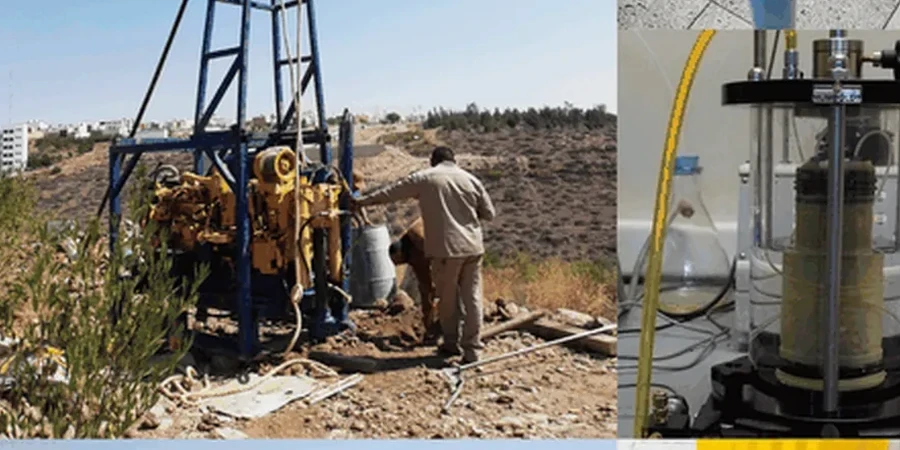
Our approach and scope
Local geotechnical context
Louisville's expansion eastward into the Floyd's Fork basin during the 2000s pushed development onto residual clay soils derived from the weathering of Ordovician limestone and shale. These clays exhibit medium to high plasticity (CH per USCS), with liquid limits frequently exceeding 50 percent. The geotechnical risk is not bearing capacity failure but rather long-term consolidation settlement and shrink-swell behavior under seasonal moisture fluctuations. A soil mechanics study that omits swell potential testing (ASTM D4546) and consolidation analysis on these materials leaves the structural engineer without the parameters needed to design stiffened slabs or to calculate the depth of the active zone. Furthermore, the mapped karst potential in Jefferson County means that any site within 1,000 feet of a known sinkhole requires a subsurface investigation program that explicitly evaluates the engineering properties of the clay infill material. Undrained shear strengths below 1,000 psf in these infill zones can trigger a recommendation for deep foundations or ground improvement, decisions that ripple through the project budget and schedule.
Process video
Standards that apply
ASTM D1586 Standard Test Method for Standard Penetration Test (SPT) and Split-Barrel Sampling of Soils, ASTM D2487 Standard Practice for Classification of Soils for Engineering Purposes (Unified Soil Classification System), ASCE 7-22 Minimum Design Loads and Associated Criteria for Buildings and Other Structures, IBC 2024 Section 1803 Geotechnical Investigations, ASTM D4767 Standard Test Method for Consolidated Undrained Triaxial Compression Test for Cohesive Soils
Complementary services
Index Property and Classification Testing
Moisture content, Atterberg limits, grain size distribution by sieve and hydrometer, and specific gravity. These tests establish the USCS classification and supply the baseline data for correlating with SPT N-values and CPT tip resistance. The liquidity index derived from these results helps assess the sensitivity of local clays to disturbance during sampling and construction.
Shear Strength and Consolidation
Consolidated-undrained triaxial compression tests with pore pressure measurement on undisturbed Shelby tube samples, plus one-dimensional consolidation tests to determine compression index, recompression index, and coefficient of consolidation. Direct shear tests are also available for granular materials where undisturbed sampling is not feasible. Results feed directly into bearing capacity calculations and settlement analyses per FHWA and NAVFAC methodologies.
Compaction and Swell Potential
Standard and modified Proctor compaction tests establish the moisture-density relationship for fill placement specifications. For the expansive residual clays common in eastern Jefferson County, swell-consolidation testing per ASTM D4546 Method A quantifies the percent swell under a range of surcharge pressures, providing the data needed to design moisture-conditioned subgrades or to specify lime treatment depths.
Typical parameters
Common questions
What laboratory tests are included in a soil mechanics study for a Louisville site?
The scope depends on the stratigraphy but typically includes moisture content, Atterberg limits (liquid limit and plastic limit), particle size analysis (sieve and hydrometer), specific gravity, unconfined compression on cohesive samples, consolidated-undrained triaxial compression with pore pressure measurement, and one-dimensional consolidation. For sites with residual clay, swell potential testing per ASTM D4546 is added. The testing program is designed to meet the requirements of IBC Section 1803 and to supply the parameters needed for both bearing capacity and settlement calculations.
How long does a complete soil mechanics study take from sample delivery to final report?
Index properties and classification can be reported within 5 to 7 business days. A full program including triaxial shear and consolidation testing requires 3 to 4 weeks because consolidation tests run for a minimum of 24 hours per load increment, and triaxial specimens must be saturated and consolidated prior to shearing. Expedited schedules are possible with advance coordination, particularly for the consolidation phase where parallel test setups can reduce turnaround time.
What is the typical cost range for a soil mechanics study in Louisville?
For a residential or light commercial project, a soil mechanics study with index testing, unconfined compression, and one consolidation test typically falls between US$3,110 and US$4,810. Commercial and institutional projects requiring multiple triaxial tests, swell-consolidation analysis, and advanced interpretation will exceed this range. The final cost depends on the number of samples, the testing suite selected, and whether the program must comply with additional agency requirements such as MSD or KYTC specifications.
How do karst conditions in Jefferson County affect the testing program?
Karst introduces abrupt lateral variability that standard grid sampling may miss. When a soil mechanics study is performed for a site in a karst-prone area, the laboratory program must include enough specimens to characterize both the intact residual soil and the clay infill within solution features. Undrained shear strength of the infill can be an order of magnitude lower than the surrounding material. We recommend running Atterberg limits and pocket penetrometer correlations on every Shelby tube segment from depths where pinnacled rock is suspected, so the geotechnical engineer can map the soft zones and decide whether deep foundations or ground improvement is warranted.