Louisville’s geology is a tale of two conditions: dense limestone karst on the east side, and 40 to 60 feet of loose alluvial sand and silt along the Ohio River floodplain. When a project lands on those water-laid deposits, standard shallow foundations become a gamble. We apply vibrocompaction design to densify those loose granular layers before the first yard of concrete is poured. The method uses a depth vibrator to rearrange soil particles into a tighter matrix—reducing future settlement and boosting bearing capacity. In the Butchertown and Portland neighborhoods, historic fills add another layer of unpredictability. A well-calibrated vibrocompaction grid, paired with CPT testing before and after treatment, gives us the verification data that Louisville Metro building officials and geotechnical reviewers expect under the current IBC. We don’t guess at relative density; we target a minimum 70% Dr and prove it with post-treatment cone resistance.
In Louisville’s floodplain, vibrocompaction routinely takes loose sand from 40% relative density to over 75%—transforming a settlement-prone profile into a buildable stratum.
Our approach and scope
Local geotechnical context
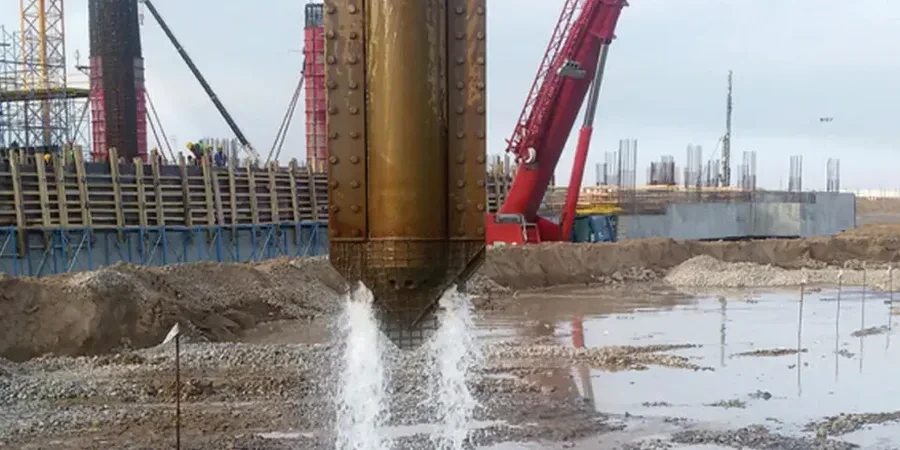
The vibrator itself is a 12- to 16-inch diameter steel probe with an eccentric weight spinning at 1,800 rpm, suspended from a crawler crane or purpose-built rig. Water jets at the tip assist penetration through silty layers. The real risk in Louisville isn’t the equipment—it’s the subsurface variability. We’ve seen a single site transition from clean sand to fat clay within 30 horizontal feet, a remnant of oxbow lake deposits from the ancestral Ohio River channel. If the vibrocompaction design doesn’t account for those clay lenses, the result is wasted energy and non-uniform densification. We cross-reference historic USGS quadrangle maps and existing geotechnical logs from nearby bridges and floodwall projects before we set the first probe point. When karst voids are suspected below the alluvium, we limit vibrator penetration above the rockhead and switch to a controlled modulus column solution instead. The key is knowing when to stop vibrating and start adapting.
Standards that apply
IBC 2021 (Chapter 18: Soils and Foundations), ASCE 7-22 (Seismic Ground Motion Parameters for Louisville Metro), ASTM D1586 (Standard Penetration Test), ASTM D2487 (Unified Soil Classification System), ASTM D5778 (CPT — electronic friction cone and piezocone)
Complementary services
Vibrocompaction Trial Program and Production Design
We design the test section layout, run the trial probes, and calibrate the vibrator parameters—amperage, pull-down speed, and step interval—against real-time CPT verification. Once the trial confirms densification to 70% Dr or better, we lock the production grid and issue the stamped design package for Louisville Metro permit review.
Post-Treatment Verification and As-Built Reporting
After production compaction, we execute the verification plan: CPT soundings at grid centroids, SPT borings at specified locations, or Becker penetration tests in gravelly zones. All data runs through our geotechnical database. The final report includes pre- and post-treatment depth profiles, relative density charts, and a signed engineer’s certification.
Typical parameters
Common questions
What soil types in Louisville respond best to vibrocompaction?
Clean to silty sands with less than 15% fines content and less than 3% clay fraction give the most predictable results. Much of the Ohio River alluvium in Louisville falls into that category—SP, SP-SM, and SM soils per ASTM D2487. The method does not densify cohesive clays; if your site has thick clay lenses from old oxbow deposits, we recommend stone columns or rigid inclusions instead.
How do you verify that the ground improvement actually worked?
We run CPT soundings before treatment to establish the baseline relative density, then repeat the soundings at the centroid of each compaction grid cell after treatment. The cone tip resistance must show a statistically significant increase—typically a 50–100% jump in qc—across the treatment depth. We also correlate CPT data with SPT blow counts where Louisville Metro requires N-value verification for spread footing design.
What is the typical cost range for vibrocompaction design and QA/QC in Louisville?
For a typical commercial or industrial site in Louisville, vibrocompaction design, trial program supervision, and post-treatment verification run between US$1,520 and US$5,740 depending on the treatment area, number of verification points, and whether Becker penetration testing is needed for gravelly zones. The vibrocompaction contractor’s production pricing is separate and varies by probe depth and grid spacing.
Does vibrocompaction trigger karst collapse in Louisville's limestone zones?
It can if not managed properly. We always review existing karst maps and geotechnical data for the project site. Where voids or pinnacled rock are suspected within 10 feet of the planned vibrator tip depth, we either raise the termination depth, switch to a low-energy compaction method, or perform pre-treatment grouting. The vibrator’s real-time amperage signature also alerts us to sudden voids—the current drops sharply when the probe loses confinement.
How long does a vibrocompaction program take on a typical Louisville site?
A trial program with three to five probes and CPT verification usually takes two to three field days. Production compaction moves at 40 to 60 probes per day with one rig, so a one-acre site with a 9-foot triangular grid finishes in about a week. Verification CPT adds one to two days. The full design-to-report cycle, including lab classification of soil samples, spans approximately three to four weeks.