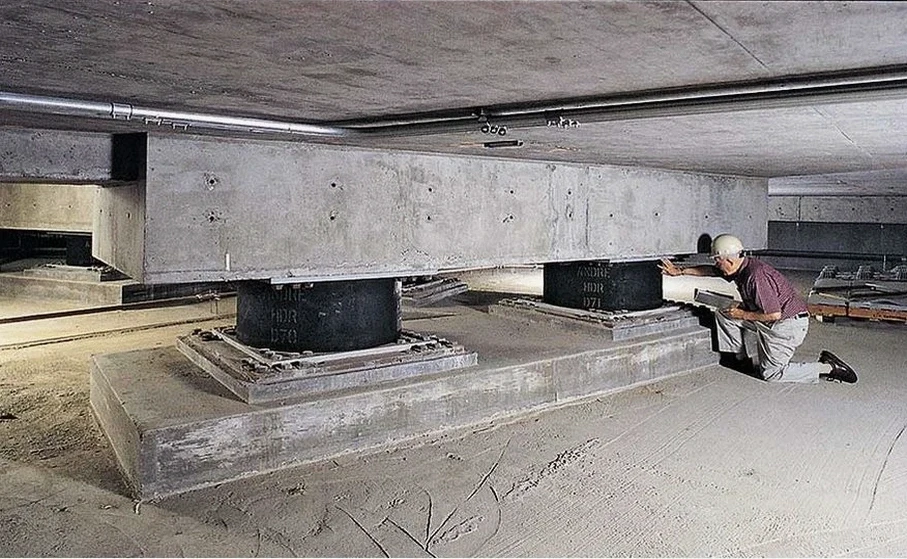
ASCE 7-22 and the Kentucky Building Code impose specific seismic design requirements across Jefferson County, where Louisville's position near the Wabash Valley and New Madrid seismic zones demands careful base isolation engineering. The city sits at an elevation of 466 feet above sea level, underlain by thick alluvial deposits from the Ohio River floodplain—fine-grained silts and clays interbedded with sand lenses that amplify ground motion during distant events. Our laboratory executes the geotechnical characterization that feeds isolation system design: dynamic soil properties, shear wave velocity profiles, and site-specific response spectra. Without this data, even the most sophisticated elastomeric or friction pendulum isolators operate on assumptions. We pair in-situ testing with laboratory dynamic analysis to build the subsurface model that isolation designers need, referencing seismic microzonation studies and local borehole records to capture Louisville’s soil variability across the city’s distinct terraces and floodplain zones.
On Louisville’s Site Class E and F soils, base isolation typically reduces seismic forces by 60 to 80 percent compared to fixed-base design, but only when isolator properties are calibrated to site-specific ground motion spectra.
Our approach and scope
Local geotechnical context
Louisville’s climate swings from humid subtropical summers to freezing winters, with 45 inches of annual precipitation saturating the silty clay overburden year-round. This moisture regime keeps the upper 15 feet of soil at high plasticity—liquid limits routinely exceed 50—which degrades shear modulus and amplifies long-period ground motion during seismic events. A base isolation design that ignores seasonal variation in soil stiffness can underestimate isolator displacement by 20 percent or more. The Ohio River’s historic flood levels, including the 1937 crest at 51.1 feet on the upper gauge, also introduce liquefaction risk in loose point-bar sands that underlie portions of downtown and the industrial districts along River Road. Our laboratory runs cyclic triaxial and resonant column tests on undisturbed Shelby tube samples to measure shear modulus reduction (G/Gmax) and damping ratio curves specific to Louisville’s alluvium, feeding these directly into the nonlinear time-history analysis that validates isolator performance under MCER ground motions.
Standards that apply
ASCE/SEI 7-22: Minimum Design Loads and Associated Criteria for Buildings and Other Structures, 2024 Kentucky Building Code (KBC) Chapter 16, referencing IBC 2024, ASTM D7400: Standard Test Methods for Downhole Seismic Testing, ASTM D4015: Standard Test Methods for Modulus and Damping of Soils by Resonant-Column Method, ASTM D3999: Standard Test Methods for the Determination of the Modulus and Damping Properties of Soils Using the Cyclic Triaxial Apparatus
Complementary services
Site-Specific Seismic Hazard and Soil Dynamic Characterization
We execute downhole seismic and crosshole tests to measure shear wave velocity profiles to 100 feet, classify the site per ASCE 7 Table 20.3-1, and develop site-specific response spectra using DEEPSOIL or equivalent 1D nonlinear analysis. The deliverable includes G/Gmax and damping curves from resonant column and cyclic triaxial tests on undisturbed specimens, plus MCER-level acceleration time histories scaled to the project’s target spectrum for use in nonlinear isolation system modeling.
Isolation System Design Support and Peer Review Data Packages
Working alongside the structural engineer of record, our team compiles the geotechnical data package required for ASCE 7 Chapter 17 isolation design and peer review: borehole logs with SPT N-values and soil classification per ASTM D2487, laboratory dynamic properties, groundwater monitoring data, and liquefaction screening results. For friction pendulum systems, we supply interface friction testing on soil-structure contact materials where subgrade conditions influence isolator pedestal design. We also coordinate with the CPT testing crew when continuous soil profiling is needed to delineate thin liquefable layers that discrete SPT sampling might miss.
Typical parameters
Common questions
What’s the estimated cost range for a base isolation geotechnical investigation in Louisville?
Most Louisville projects fall between US$3,670 and US$9,360, depending on the number of borings, the depth of shear wave velocity profiling, and the quantity of resonant column and cyclic triaxial tests required. A typical two-boring program with downhole seismic to 100 feet and a full suite of dynamic laboratory tests on six specimens runs near the midpoint of that range.
Does Louisville’s building code require site-specific ground motion studies for base-isolated structures?
Yes. The 2024 Kentucky Building Code, referencing IBC 2024 and ASCE 7-22 Section 11.4.8, mandates site-specific ground motion analysis for structures on Site Class D through F when base isolation is used, unless the site class can be reliably established from nearby data. Louisville’s USGS seismic design maps supply default values, but Chapter 21 of ASCE 7 requires site-specific spectra for isolated structures assigned to Risk Category III or IV, which includes most hospitals, emergency response facilities, and schools.
How do you determine if a Louisville site has liquefaction potential that affects isolator design?
We follow the Seed & Idriss simplified procedure, using SPT blow counts and CPT tip resistance from our field program, corrected for overburden pressure and fines content per Youd et al. (2001) recommendations. In Louisville’s Ohio River floodplain, we screen saturated sands and silty sands within the upper 50 feet. If the factor of safety against liquefaction drops below 1.1 under the design earthquake, we quantify post-liquefaction settlement and lateral spreading displacement, which may require adjusting the isolator displacement capacity or adding ground improvement below the foundation.
What types of base isolation systems are most commonly designed for Louisville buildings?
Lead-rubber bearings and friction pendulum systems dominate Louisville projects. Lead-rubber bearings supply built-in damping through the lead core’s hysteretic behavior, typically yielding 15 to 30 percent equivalent viscous damping. Friction pendulum isolators use the slider’s radius of curvature to control period and the sliding interface to dissipate energy. The choice depends on the structure’s weight, the required displacement capacity, and the soil profile. Our laboratory provides the dynamic soil properties both systems need: shear modulus degradation curves for lead-rubber isolator modeling, and subgrade stiffness data for friction pendulum pedestal foundations on Louisville’s compressible alluvium.