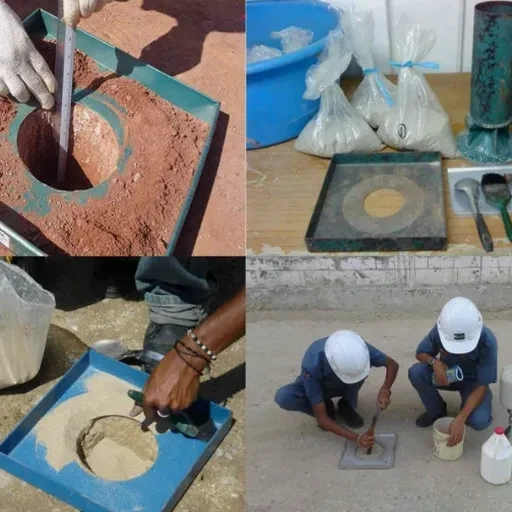
Louisville's subgrade tells a story of glacial outwash and alluvial deposits from the Ohio River. Silty sands and lean clays dominate the eastern and southern corridors. These soils shift with moisture. Density is never a given. We run the field density test using the sand cone method per ASTM D1556 to verify compaction on residential pads, commercial slabs, and utility backfill. The work is methodical. Every test gives us a dry density number. We compare it against the proctor curve. That's how we know if the fill will hold. In areas near Beargrass Creek or the floodwall zone, moisture correction becomes critical. A simple nuclear gauge reading won't capture that nuance. The sand cone density procedure gives a direct physical measurement. No calibration drift. No radiation source. Just repeatable data that an engineer can trust.
A sand cone test gives you the actual density of the soil in place. No assumptions. No extrapolations. Just a direct measurement you can defend to any inspector.
Our approach and scope
Local geotechnical context
The most common mistake we encounter is contractors who run a nuke gauge over silty clay and call it done. Louisville's red-brown residual clays hold moisture unevenly. A nuclear gauge reads hydrogen. It interprets water as density. You get a false high. The sand cone method eliminates that error. It measures mass and volume directly. No moisture interference. We've re-tested sites where nuke gauge readings showed 98 percent compaction. The sand cone came back at 89. That's a failing subgrade. The fix costs time and money. A plate load test helps quantify the consequence of that undercompaction in terms of settlement and modulus. But the first step is getting the density number right. The sand cone does that.
Standards that apply
ASTM D1556 – Standard Test Method for Density and Unit Weight of Soil in Place by Sand-Cone Method, ASTM D698 – Standard Test Methods for Laboratory Compaction Characteristics of Soil Using Standard Effort, ASTM D1557 – Standard Test Methods for Laboratory Compaction Characteristics of Soil Using Modified Effort, IBC Section 1803.5 – Foundation and Soil Investigation Requirements, Kentucky Building Code (KBC) – adopted with local amendments to IBC
Complementary services
Backfill and utility trench compaction testing
We verify compaction in lift increments for storm drainage, sewer, and waterline trenches. Municipal inspectors in Jefferson County require documented density results before allowing pavement restoration.
Building pad and slab-on-grade verification
Before concrete placement, we test the upper subgrade. Residential and commercial projects across Louisville Metro rely on these results to satisfy building department requirements under IBC Chapter 18.
Typical parameters
Common questions
How much does a field density test using the sand cone method cost in Louisville?
The typical cost ranges from US$90 to US$170 per individual test point. The exact price depends on the number of tests requested, travel distance to the site, and whether the project requires same-day reporting. For larger projects with multiple lift inspections, we can structure a daily rate that reduces the per-test cost.
Which ASTM standard governs the sand cone density test?
ASTM D1556 is the primary standard for determining in-place density and unit weight of soil using the sand cone method. It applies to soils with a maximum particle size typically under 2 inches. The method is not suitable for very soft clays or soils with a high volume of coarse rock fragments.
How does the sand cone method differ from a nuclear density gauge?
The sand cone method measures density directly by excavating a known volume of soil and weighing it. A nuclear gauge estimates density indirectly by measuring radiation scatter, which can be affected by moisture content and soil chemistry. The sand cone requires more labor per test, but the result is a direct physical measurement with no calibration drift over time.
What acceptance criteria apply to compaction testing in Louisville?
Structural fill beneath foundations and slabs typically requires a minimum of 95 percent of the maximum dry density as determined by ASTM D698 standard proctor. Pavement subgrade often requires 95 to 98 percent. The exact threshold is specified in the project geotechnical report or the Louisville Metro building permit conditions.