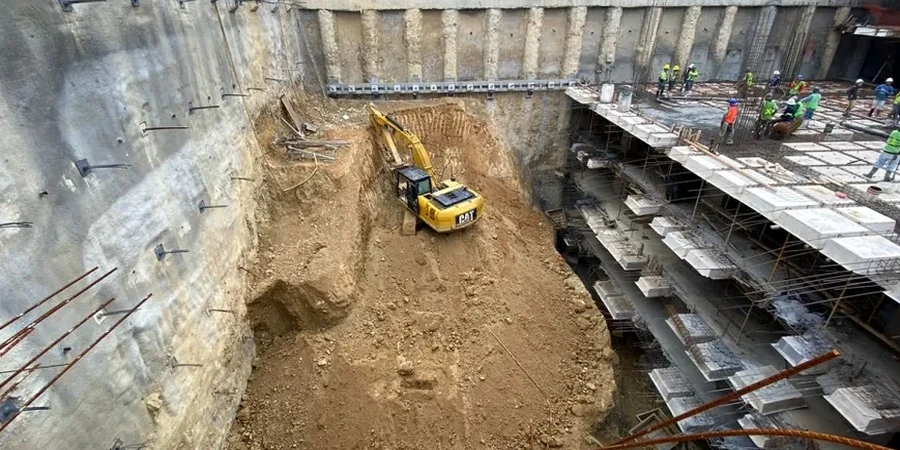
Louisville sits on a geological timeline that runs from Ordovician limestone to thick Ohio River alluvium, and that legacy surfaces the moment you go below grade. Downtown basements punch into glacial outwash, while infrastructure excavations along the waterfront hit water-bearing sands at depths that turn a routine dig into a managed risk. The city’s karst bedrock — riddled with voids and solution channels — demands a design approach that reads the ground before the first bucket moves. Our geotechnical design for deep excavations integrates the CPT test to map continuous soil profiles where SPT blow counts alone miss thin drainage layers, and we pair that with excavation monitoring to track lateral movement in real time, keeping adjacent structures safe when the cut goes deep.
Designing a deep excavation in Louisville means assuming karst features will surprise you, then building the monitoring plan to catch them before they become a problem.
Our approach and scope
Local geotechnical context
IBC Chapter 18 and ASCE 7-22 set the baseline, but Louisville’s karst terrain adds a failure mode that standard earth pressure theory doesn’t capture: sudden ground loss into pre-existing voids. When a soldier pile socket terminates in apparently competent limestone that actually bridges a dissolution cavity, the entire wall can lose toe resistance without warning. That’s why our design for deep excavations mandates continuous rock coring at each soldier pile location east of I-65, where the Louisville Limestone and Waldron Shale contact creates preferential solutioning. The other monster is hydrostatic pressure: Ohio River stage data going back to the 1937 flood shows that a 15-foot stage rise translates to a 12-foot phreatic surface jump in the alluvium within 48 hours. A design that ignores that transient condition puts the excavation bottom at risk of heave and the bracing at risk of overload. We size dewatering systems for the 100-year event and specify instrumentation trigger levels so the contractor knows exactly when to switch from normal pumping to emergency mode.
Standards that apply
IBC 2021 Chapter 18 (Soils and Foundations), ASCE 7-22 Minimum Design Loads, ASTM D1586 Standard Penetration Test, ASTM D2487 Soil Classification, FHWA GEC No. 4 Ground Anchors and Anchored Systems
Complementary services
Shoring and Bracing Design
Complete structural design of soldier pile, secant pile, and diaphragm wall systems with internal bracing or tiebacks, including staged excavation analysis that matches the contractor’s actual sequence.
Dewatering and Groundwater Control
Hydrogeologic modeling and well system design to lower the phreatic surface below excavation subgrade, with contingency plans for karst conduit flow that can overwhelm standard wellpoint arrays.
Instrumentation and Monitoring Plans
Specification of inclinometers, piezometers, crack gauges, and optical survey targets with threshold values tied to serviceability limits for adjacent structures and utilities.
Typical parameters
Common questions
What does geotechnical design for a deep excavation typically cost in Louisville?
Fees for a complete deep excavation design package in the Louisville metro area generally range from US$2,030 for a straightforward single-basement shoring plan to US$7,240 for a multi-level excavation with dewatering design, instrumentation specifications, and karst mitigation protocols. The final cost depends on excavation depth, proximity to adjacent structures, and whether probe drilling and rock coring are required to map the limestone surface.
How does karst geology affect deep excavation design in Louisville?
Karst introduces two primary risks: voids that can cause sudden loss of bearing at soldier pile tips, and solution channels that create preferential groundwater flow paths. Our designs address both by requiring continuous rock coring at support element locations east of I-65, grout take monitoring during socket drilling, and dewatering systems sized for the possibility of conduit flow that bypasses the porous media assumptions in standard well formulas.
When does Louisville code require a registered design professional for excavation support?
Under IBC 2021 as adopted by Louisville Metro, excavations exceeding 5 feet in depth that will be entered by workers require a protective system designed by a qualified person. When adjacent structures or right-of-way are within the zone of influence — generally a distance equal to the excavation depth — the shoring design must be sealed by a licensed professional engineer. This applies to nearly every commercial excavation in the downtown and NuLu districts.