The contrast between the deep, well-drained gravels out by the Gene Snyder Freeway corridor and the fat clays underlying old neighborhoods like Germantown is something you learn fast when specifying anchors in Louisville. The Ohio River floodplain deposits, mixed with our infamous karst limestone pinnacles, create a subsurface where a one-size-fits-all tieback design simply won't work. We've pulled enough bond-length calculations on Shelbyville Road projects to know that active anchors need careful grout-to-ground verification in the soft shale zones, while passive systems often outperform expectations in the dense glacial outwash. A proper anchor design here starts with a stratigraphic model that accounts for the limestone bedrock's unpredictable surface, often verified with a test pits investigation to map the overburden thickness before any drilling begins.
In Louisville's karst, an anchor's capacity is only as reliable as the rock it's bonded into — and that rock can change within 10 feet of drilling.
Our approach and scope
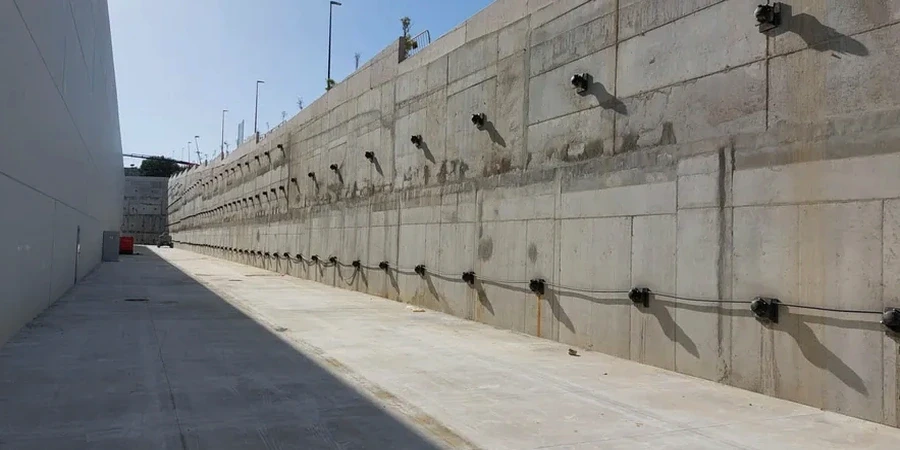
Local geotechnical context
IBC Chapter 18 and the local Louisville Metro Building Code amendments place anchor design squarely under the responsibility of a licensed geotechnical engineer — and for good reason in this city. The karstic limestone beneath Louisville can contain solution cavities, clay-filled seams, and near-vertical jointing that create preferential grout paths and sudden loss of bond capacity. A passive anchor installed into a seam of weak, weathered rock might not mobilize the intended resistance until unacceptable wall deflections have already occurred. In our team's workflow, we never rely on a single exploration boring for an anchored wall alignment; the risk of hitting a pinnacle versus a trough in the rock surface is too high. We specify inclined probe holes at each anchor location when the rock surface profile shows more than 5 feet of relief across the wall footprint, and we correlate the findings with a seismic refraction line to reduce the chance of drilling into an undocumented void.
Standards that apply
IBC 2021 Chapter 18 (Soils and Foundations), ASTM D1586 (Standard Penetration Test), PTI DC35.1 (Recommendations for Prestressed Rock and Soil Anchors), ASTM A416 (Steel Strand, Uncoated Seven-Wire for Prestressed Concrete), ACI 318-19 Chapter 17 (Anchoring to Concrete)
Complementary services
Active Tieback Systems
Prestressed anchors for soldier pile and secant pile retaining walls, designed with lock-off loads calibrated to limit lateral movement in sensitive adjacent structures.
Passive Rock Dowels
Fully grouted, untensioned bars for slope stabilization and gravity wall reinforcement in the limestone and shale formations common to Louisville's hillsides.
Pre-Production Anchor Testing
Full-scale pullout and creep tests per PTI recommendations, with digital load-displacement monitoring to validate bond zone capacities before production drilling begins.
Anchor Installation Oversight
Field supervision of drilling, tendon placement, and grouting operations, including water-take testing in karst zones to detect grout loss into solution features.
Typical parameters
Common questions
What's the difference between an active and a passive anchor?
An active anchor is tensioned to a specified lock-off load after grouting, actively compressing the soil or rock mass behind a retaining wall. A passive anchor is simply grouted in place and only develops resistance when the ground moves. In Louisville's clays, we often use active anchors to limit initial wall deflection to less than half an inch, which is critical when protecting adjacent historic brick foundations in neighborhoods like Butchertown.
How deep do anchors need to go in Louisville's limestone?
The bond zone in competent limestone typically requires a minimum 10-foot socket, but the total anchor length depends on where that competent rock begins. In the east end, we might hit solid limestone at 15 feet; near the river, it can be 60 feet or more. We always verify rock quality with SPT N-values and core recovery before fixing the final bond length.
What does an active/passive anchor design cost for a typical Louisville retaining wall?
A full anchor design package, including calculations, construction drawings, and pre-production testing specifications, typically ranges from US$920 to US$3,660 depending on the wall length and the number of anchor rows. The fee includes the PE-stamped submittal ready for Louisville Metro review.
Do I need a building permit for anchored retaining walls in Louisville?
Yes. Any retaining wall over 4 feet in height requires a permit from Louisville Metro Planning & Design solutions, and anchored walls supporting a surcharge or adjacent property typically require a geotechnical report stamped by a Kentucky-licensed engineer. We prepare the complete submittal package with all required calculations and construction notes.
How do you verify anchor capacity in karst conditions?
We perform pre-production proof tests on sacrificial anchors at the start of the job, loading to 133% of the design load and monitoring creep over 60 minutes. In karst, we also do water-pressure testing in the bond zone before grouting to check for open fractures that could steal grout. If excessive take is observed, we grout the zone first, redrill, and test again before installing the production tendon.