Louisville sits on a limestone karst plain. That means cavities, pinnacled bedrock, and highly variable overburden. A standard spread footing is a gamble here. We deploy raft and mat foundation design as the primary risk mitigation tool for structures on erratic ground. The Ohio River alluvium adds another layer: loose sands and soft clays up to 40 feet deep near the floodplain. Our team correlates subsurface data from CPT testing and SPT drilling directly into finite element models. We do not guess. We measure, model, and design mats that bridge subsurface anomalies. The goal is uniform settlement control, even when the bearing stratum drops three feet in ten lateral feet. Louisville's 2021 market surge brought rushed foundation decisions. We fix those.
In Louisville karst, a well-designed mat doesn't just support a building. It bridges the unknown.
Our approach and scope
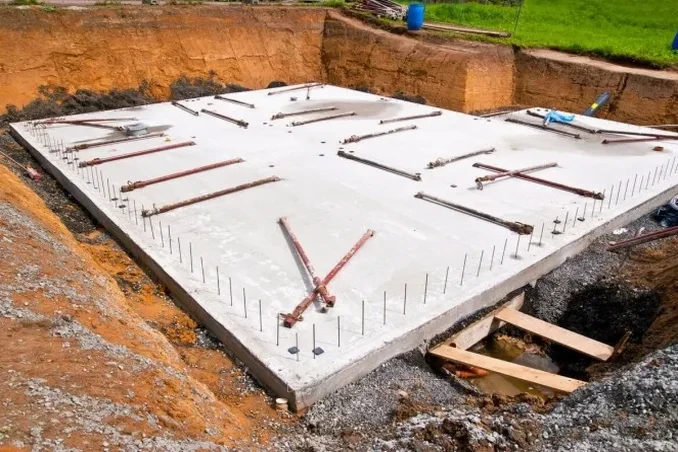
Local geotechnical context
The most common failure we see in Louisville is ignoring the karst contact. A contractor excavates, sees stiff red clay, and calls it good. But pinnacled bedrock can be two feet below that clay. Differential weathering creates a hard point. The mat cracks directly above it because the stiffness contrast was never modeled. Another frequent error: using a uniform subgrade modulus from a desktop study. In the Ohio River flood zone, a mat without a proper buoyancy check floats during a 50-year event. We have remediated slabs that lifted 1.5 inches and cracked interior partitions. The fix costs triple the original mat upgrade. The Kentucky Building Code requires a geotechnical investigation per Section 1803. We enforce that. No exceptions. Our designs always include a karst contingency plan with low-mobility grouting if voids are encountered.
Process video
Standards that apply
IBC 2021 (Kentucky Building Code adoption), ASCE 7-22 Minimum Design Loads, ACI 318-19 Building Code for Structural Concrete, ASTM D1586 Standard Penetration Test, ASTM D2487 Soil Classification
Complementary services
Karst-Tolerant Mat Design
Full 3D finite element modeling of mat foundations bridging mapped or suspected sinkhole zones. Includes staged construction analysis and reinforcement optimization for abrupt subgrade changes.
Floodplain Mat Engineering
Design for hydrostatic uplift, scour protection, and saturated subgrade modulus reduction. We handle the interface between the mat, the floodwall, and deep foundations when needed.
Typical parameters
Common questions
What's the difference between a raft foundation and a regular slab-on-grade?
A slab-on-grade bears directly on the ground and is not structural in the building frame. A raft or mat foundation is a structural slab designed to carry and distribute column and wall loads to the soil. In Louisville's karst terrain, we use mats to span soft spots and reduce differential settlement. The thickness is typically 12 to 36 inches with top and bottom reinforcement, versus a 4-inch non-structural slab.
How much does a raft/mat foundation design cost for a Louisville project?
Our structural and geotechnical design package for a raft or mat foundation typically ranges from $990 for a straightforward single-family residential mat up to $3,830 for a complex mid-rise commercial mat requiring full 3D FEM, karst assessment, and floodplain buoyancy analysis. Every project receives a fixed-fee proposal after we review the architectural loads and the geotechnical report.
Do I need a mat foundation if my site is not in a flood zone?
Flood risk is only one driver. In Louisville, karst is the bigger factor. If your geotechnical report shows erratic bedrock depth, soft clay lenses, or sinkhole influence zones, a mat foundation distributes loads and prevents differential settlement that would crack a conventional footing system. We recommend mats whenever the variability index across the site exceeds 30 percent.
How do you handle the risk of sinkholes under a mat foundation?
We map the site with electrical resistivity and CPT soundings to identify low-density zones. The mat is then designed as a stiffened raft with thickened ribs over suspected features. If a void is confirmed, we specify low-mobility grouting to fill it before pouring the mat. The mat reinforcement is detailed to cantilever over a design void size, typically 5 to 10 feet in diameter, based on the Kentucky Geological Survey's regional data.
What are the IBC requirements for mat foundation design in Kentucky?
The Kentucky Building Code adopts IBC 2021. Section 1803 requires a geotechnical investigation. Section 1808 addresses foundations, and ACI 318-19 governs the structural concrete design. Our mats are designed for the load combinations in ASCE 7-22 Chapter 2, including flood loads in Zone A and AE. We also comply with Louisville Metro's stormwater ordinance when mat elevation affects site drainage.