The Ohio River doesn’t just shape Louisville’s skyline—it defines what lies beneath. Alluvial silts and sands up to 30 meters deep blanket much of the metro area, left by millennia of flooding. Combine that with karst limestone dissolving into sudden sinkholes, and a retaining wall here faces conditions most textbooks don’t cover. Design in Jefferson County demands more than just resisting lateral earth pressure; it requires anticipating how saturated backfill behaves during a spring thunderstorm and what happens when a void opens five meters behind the wall.
We approach each retaining wall design by first mapping the stratigraphy through targeted subsurface investigation, often pairing borings with CPT testing in the floodplain where soft clays dominate. For sites near the knobs region where weathered shale appears, the load path changes entirely—and so does our reinforcement strategy.
A retaining wall in Louisville must handle not just the soil it holds back, but the water that moves through it—and the limestone voids that may open beneath it.
Our approach and scope
Our designs follow IBC Chapter 18 and ASCE 7-22 for seismic loading in Seismic Design Category B, which Louisville falls under. We routinely specify ASTM D2487 for soil classification and run direct shear on reconstituted samples to nail down the friction angle behind the wall. Key parameters we control in every deliverable include:
- Active and at-rest earth pressure coefficients (Ka, Ko) calculated per Rankine or Coulomb, depending on wall batter and backfill slope.
- Global stability analysis using Spencer’s method in Slide2, verifying factors of safety above 1.5 for static and 1.1 for seismic.
- Drainage design with granular chimney drains and toe underdrains, sized for Louisville’s 4.2-inch average monthly rainfall in May.
- Bearing capacity checks on the foundation soil, often supplemented with a plate load test when footings land on variable fill.
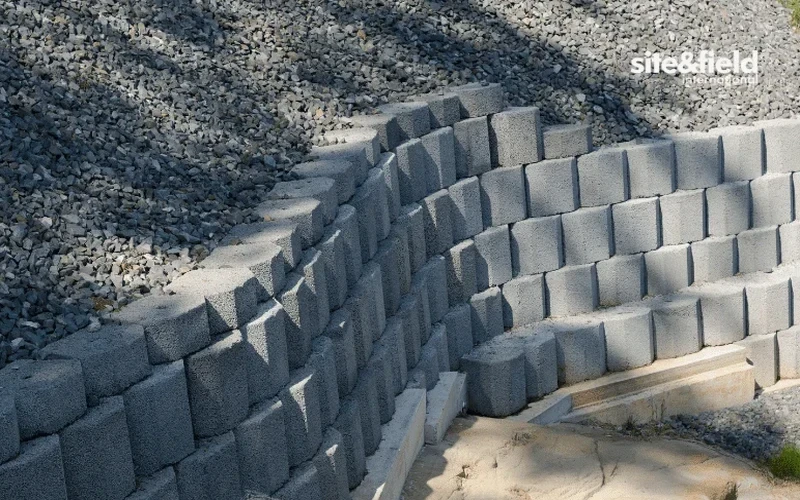
Local geotechnical context
The risk profile for a retaining wall changes dramatically between Louisville’s east end and the River Road corridor. In the east, residual clay over limestone creates a perched water table that saturates backfill after heavy rain, spiking hydrostatic pressure well beyond design assumptions if drains clog. Along River Road, loose alluvial sands are prone to scour during high-water events, undermining the wall toe before any structural failure occurs.
Karst subsidence is the wildcard. A 2019 sinkhole on Frankfort Avenue swallowed a section of sidewalk with no warning—the same mechanism can rotate a wall overnight. We address this by overlaying Kentucky Geological Survey karst maps with our borings, identifying paleosinks before they become problems. When the risk is high, we integrate stone columns to stabilize the foundation soil or specify deeper shear keys that bridge small voids. Construction-phase monitoring with inclinometers and piezometers catches movement early, before it becomes a claim.
Standards that apply
IBC 2021 – Chapter 18 (Soils and Foundations), ASCE 7-22 – Minimum Design Loads (Seismic, Section 11.4), ASTM D2487 – Unified Soil Classification System, ASTM D3080 – Direct Shear Test, AASHTO LRFD Bridge Design Specs (9th Ed, Section 11)
Complementary services
Gravity and Cantilever Wall Design
Reinforced concrete walls for cuts up to 6 meters, with overturning, sliding, and bearing checks per IBC 1807.2.
MSE Wall Design with Geogrid
Mechanically stabilized earth solutions for highway and commercial projects, including internal and external stability analysis.
Sheet Pile and Soldier Pile Walls
Cantilevered and anchored sheet pile designs for floodwall extensions and riverbank stabilization along the Ohio River.
Construction-Phase Monitoring
Inclinometer arrays, settlement plates, and piezometers to verify wall performance during and after backfilling.
Typical parameters
Common questions
What is the typical cost range for retaining wall design in Louisville?
For a standard cantilever or MSE wall in the Louisville metro area, our design fees typically range from US$1,030 to US$4,440 depending on wall height, site access, and the number of borings required. Complex sites with karst investigation or anchored systems fall toward the upper end.
How does Louisville’s karst geology affect retaining wall foundations?
Karst introduces the risk of sudden ground collapse from solution cavities in the limestone. We cross-reference Kentucky Geological Survey sinkhole data with our own subsurface investigation, and when paleosinks are identified, we either relocate the wall, grout the cavity, or design a geogrid-reinforced soil bridge to span the void.
What drainage provisions do you include in Louisville designs?
Every wall includes a granular chimney drain and a 4-inch perforated toe underdrain that daylights to a storm sewer or swale. We size the system for the 25-year, 24-hour storm (approximately 4.5 inches in Jefferson County) to prevent hydrostatic buildup, which is the leading cause of wall distress in our climate.
Do retaining walls in Louisville require seismic design?
Yes. Louisville is in Seismic Design Category B per ASCE 7-22, so we include a pseudo-static seismic coefficient (kh) in global stability and structural checks. Walls over 6 feet typically trigger this requirement under IBC Section 1613.
How long does the design and permitting process take?
A standard retaining wall design package—including borings, analysis, and stamped drawings—takes three to four weeks. Louisville Metro planning review adds another two to three weeks, though floodplain development permits along the Ohio River corridor can extend that timeline.