A recent mixed-use development along the Ohio River in downtown Louisville ran into a problem. The geotechnical report flagged soft, normally consolidated clays at depth, but the structural engineer needed reliable shear strength parameters to size the mat foundation and verify the proposed excavation support system. Standard penetration tests give you blow counts, but they don't tell you how the soil behaves under the actual stress path of a 60-foot excavation. That's where the triaxial test comes in. We ran a series of consolidated-undrained (CU) triaxial tests with pore pressure measurement on Shelby tube samples, and the results shifted the entire foundation strategy. In Louisville's alluvial terrace deposits and weathered shale zones, the triaxial test provides the effective stress parameters—c' and phi'—that directly feed into bearing capacity calculations and deep excavation modeling. For projects near the Ohio River floodplain, where groundwater conditions fluctuate seasonally, understanding how pore pressure development affects soil strength is not optional. It's fundamental to safe design. Our ASTM D4767 and D2850-compliant lab works alongside CPT testing to calibrate site-specific correlations for the Derby City's variable subsurface profile.
A triaxial test doesn't just give you a number—it gives you the failure envelope that governs how your foundation, slope, or excavation will perform under load.
Our approach and scope
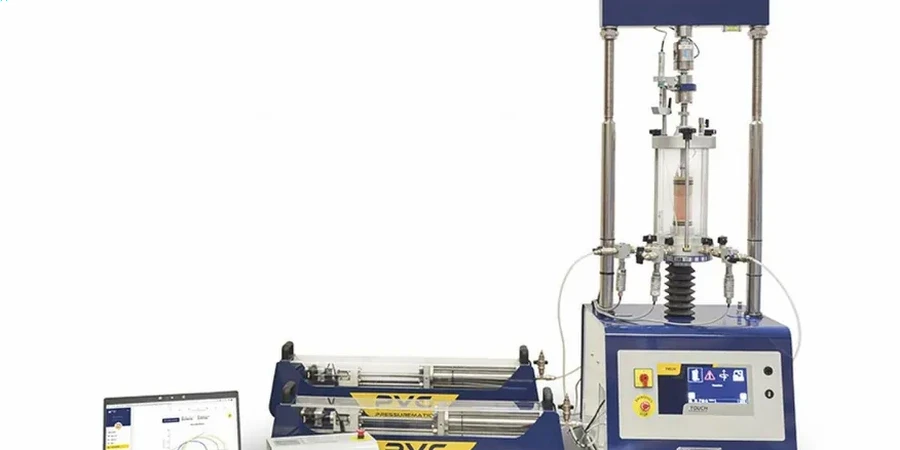
Local geotechnical context
The most common mistake we see on Louisville projects is using unconsolidated-undrained (UU) triaxial data for a problem that clearly requires effective stress parameters. A UU test on a saturated clay from the Ohio River alluvium gives you total stress parameters—an undrained shear strength that might be perfectly adequate for short-term excavation stability. But if you plug those same numbers into a long-term settlement analysis or a slope stability model for a permanent cut, you're ignoring consolidation and the resulting pore pressure dissipation, which can lead to a significant overestimation of the factor of safety. We've reviewed reports where a contractor tried to save a few hundred dollars by skipping the consolidation stage, only to end up with a retaining wall design that didn't account for the true drained strength of the Louisville clay. Another risk is inadequate saturation of the specimen. If the back pressure saturation phase isn't run properly and the B-value stays below 0.95, your pore pressure readings during shear are unreliable, and the effective stress path is meaningless. For critical infrastructure near the Beargrass Creek flood basin, that kind of error can cascade into a geotechnical failure.
Standards that apply
ASTM D4767 – Standard Test Method for Consolidated Undrained Triaxial Compression Test for Cohesive Soils, ASTM D2850 – Standard Test Method for Unconsolidated-Undrained Triaxial Compression Test on Cohesive Soils, ASTM D7181 – Standard Test Method for Consolidated Drained Triaxial Compression Test for Soils, IBC 2021 – Section 1803 Geotechnical Investigations, ASCE 7-22 – Minimum Design Loads and Associated Criteria
Complementary services
CU Triaxial with Pore Pressure Measurement
Consolidated-undrained triaxial compression per ASTM D4767. We saturate Shelby tube samples to a minimum B-value of 0.95, consolidate to the estimated in-situ effective stress, and shear at a controlled strain rate while recording pore pressure response. Ideal for foundation design in Louisville's normally consolidated Ohio River alluvium and for excavation stability analyses.
CD Triaxial for Drained Strength Parameters
Consolidated-drained triaxial compression per ASTM D7181 for projects requiring long-term effective stress parameters. We run these on granular materials and stiff clays where drained conditions govern the design, such as permanent retaining walls along I-64 corridor expansions or mat foundations on overconsolidated glacial till.
Multi-Stage Triaxial for Limited Samples
When Shelby tube recovery is limited and you can't obtain three identical specimens for a full Mohr-Coulomb envelope, we run a multi-stage triaxial test on a single specimen. The confining pressure is increased in stages after each shearing phase, providing a complete failure envelope from one sample. Common for deep borings in Louisville's mixed alluvial and residuum profile.
Typical parameters
Common questions
What does a triaxial test in Louisville typically cost?
For a standard consolidated-undrained (CU) triaxial test with three confining pressures to define a Mohr-Coulomb failure envelope, our Louisville lab typically charges between US$2,130 and US$2,370. The exact cost depends on whether you need single-stage or multi-stage testing, the strain rate requirements for your specific soil type, and whether we're testing undisturbed Shelby tube samples or recompacted specimens. This price includes back pressure saturation, consolidation, shearing, and the final engineering report with stress-strain curves, pore pressure plots, and interpreted c' and phi' values.
When do I need a triaxial test instead of a direct shear test?
You need a triaxial test when your design requires effective stress parameters with pore pressure measurement, or when you need to control the drainage conditions during shear. A direct shear test forces failure on a predetermined horizontal plane, while the triaxial test allows the specimen to fail along the weakest plane. For projects involving deep excavations, slope stability in saturated clays, or foundations where you need to differentiate between drained and undrained behavior, the triaxial test is the right tool. In Louisville's alluvial deposits along the Ohio River, where we deal with soft, normally consolidated clays, the CU triaxial gives you the undrained shear strength and the effective stress path that direct shear simply cannot supply.
How long does a triaxial test take and what sample quality do you need?
A standard CU triaxial test with three specimens takes approximately 7 to 10 business days from sample receipt to final report. The consolidation phase alone can take 24 to 48 hours for Louisville's plastic clays, and the shearing phase at the correct strain rate adds another day per specimen. We require undisturbed Shelby tube samples (3-inch diameter minimum) with no visible disturbance, cracking, or desiccation. The tubes should be sealed with wax immediately after extrusion in the field and transported upright. If you're drilling in Louisville's glacial till or alluvium, coordinate with your drill crew to minimize sampling disturbance—a rushed sample means a useless triaxial result regardless of how carefully we run the lab procedure.