Louisville’s development along the Ohio River means builders routinely encounter the soft, compressible alluvium that underlies much of the metro area. These floodplain deposits, often 30 to 60 feet thick in the downtown and Portland neighborhoods, present a real challenge: differential settlement that can crack foundations and delay project timelines. Stone column design offers a reliable ground improvement path that transforms weak, saturated silts and clays into a composite mass capable of supporting structural loads without deep foundations. By installing compacted gravel columns through the problematic strata, the technique densifies the surrounding soil and creates vertical drains that accelerate consolidation. When we evaluate a site near Beargrass Creek or out toward the East End, the first step is always correlating the subsurface profile with the loading requirements—because a stone column solution that works in glacial till won’t address the high compressibility of Louisville’s riverine clays. Complementing this with a CPT test gives us a continuous resistance profile that refines the column spacing and depth before mobilization.
A well-designed stone column grid cuts post-construction settlement by 50 to 70 percent compared to untreated alluvial ground—turning a six-month wait into a few weeks.
Our approach and scope
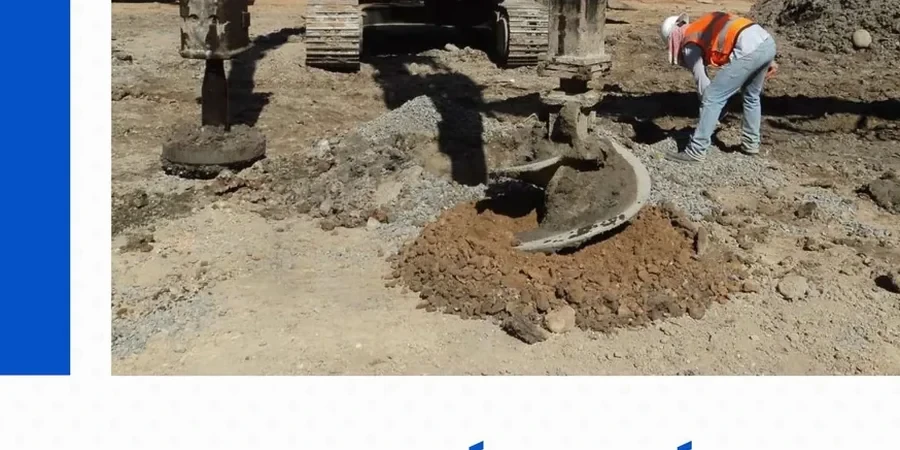
Local geotechnical context
One thing our local team notices repeatedly on Louisville sites is that untreated organic lenses within the alluvium can create isolated soft spots that escape detection with widely spaced borings. A stone column array designed without accounting for these pockets may background localized excess settlement, even when the overall factor of safety appears adequate. The practical fix starts with a tighter investigation grid—combining SPT drilling with CPT soundings at column locations—to map the variability before finalizing the layout. Another risk arises during installation near the river: artesian conditions or high groundwater can flush fines into the stone column before compaction is complete, reducing its stiffness. Our field protocols address this by adjusting the water pressure in the vibroflot and sequencing column installation to work from the perimeter inward, maintaining confinement throughout the process.
Process video
Standards that apply
FHWA Ground Improvement Manual (NHI-16-027), ASCE 7-22 Minimum Design Loads for Buildings, IBC 2024 Chapter 18 Soils and Foundations, ASTM D1586 Standard Test Method for SPT, ASTM D2487 Classification of Soils for Engineering Purposes
Complementary services
Feasibility & Settlement Analysis
We calculate area replacement ratios and estimate total and differential settlement under structural loads using finite element or axisymmetric unit-cell models calibrated to site-specific consolidation data.
Column Layout & Installation Specs
Detailed grid design with column diameter, depth, spacing, stone gradation, and installation sequence—coordinated with your structural engineer for column-to-footing load transfer.
Quality Control & Verification Testing
On-site monitoring of amperage, stone volume, and penetration rate during installation, plus post-treatment plate load tests or CPT soundings to confirm performance.
Integration with Deep Foundations
For sites where stone columns transition to piles at depth or along the perimeter, we design the hybrid system to control differential movement at the interface.
Typical parameters
Common questions
How much does stone column design cost for a typical Louisville commercial site?
For a standard commercial lot in Jefferson County, our stone column design fees range from US$1,370 to US$5,510, depending on the number of columns, depth of treatment, and complexity of the subsurface conditions. This covers the geotechnical analysis, settlement calculations, column layout drawings, and installation specifications.
How long does consolidation take after installing stone columns in the Ohio River floodplain?
The stone columns act as vertical drains, so primary consolidation that might take 6 to 12 months in untreated Louisville alluvium typically completes in 2 to 6 weeks after installation. We confirm the degree of consolidation with settlement plates or piezometers before the structural contractor mobilizes.
Can stone columns replace deep foundations entirely on a Louisville site?
In many cases yes—particularly for lightly to moderately loaded structures like warehouses, low-rise commercial buildings, and embankments. The decision depends on the undrained shear strength of the native soil; if it's below about 15 kPa, we may need to combine stone columns with a load transfer platform or transition to a mat foundation solution.
What verification testing do you perform after stone column installation?
We typically run a combination of plate load tests on selected columns and CPT soundings between columns to measure the increase in tip resistance and sleeve friction. The acceptance criteria are tied to the design modulus and allowable settlement specified in the project geotechnical report.